

Introducing Archiveadelphia
And a look at the origins of Hopkinson House

Welcome to Archiveadelphia, an aspirationally-weekly newsletter that aims to explore the fascinating history of Philadelphia using newspaper and magazine archives and public domain images. I’m hoping to offer the following two features, “Five Philhistory Nuggets” and “The Weekly Phuilding,” every week—please send me any Philly history topics (a building, a law, a scandal, a song) you would like for me to explore, or any other types of modules you’d most like to see!
FIVE PHILHISTORY NUGGETS
This missive will always open with five grab-bag historical Philadelphia explorations that have excited me over the previous week. Here’s a first smattering:
My wife Zara and I have been reading aloud the papers of the fascinating Peale family, the brood of painters, museum founders, scientists, and politicians who left a massive footprint on Philadelphia. We were particularly stunned by the revelation that Charles Wilson Peale and his son Rembrandt went on a joyful father-son jaunt to exhume the remains of a mastodon in Upstate New York in 1801. As someone who remembers watching the iconic 2000 Discovery Channel quasi-documentary Raising the Mammoth, I found this a truly awe-inspiring endeavor. Hans-Dieter Sues, the Curator of Vertebrate Paleontology at the National Museum of Natural History, wrote this wonderful article explaining the broader context of the dig.
In October, Zara and I hiked a portion of the emerging Delaware River Heritage Trail, from Trenton (very easy NJ Transit ride from Center City!) down to Roebling (very easy River Line back to Camden and either PATCO or walk over the Ben Franklin Bridge!), and I’ve been thinking about the journey ever since. The trail has lots of historical markers and moments of beauty, and we were particularly taken with Roebling, a former company town constructed in the early 1900s. The town housed the employees of Kinkora, a rope plant and steel mill that bridge builder Charles Roebling—son of pioneering Brooklyn Bridge genius John Roebling—used to make the wire for the George Washington and Golden Gate Bridges. We sadly missed the opening hours of the Roebling Museum (a return is imminent), but we loved seeing the well-preserved 750 brick homes that made up the town back when Kinkora was firing. Plus, the end-of-hike pizza at the very retro Palermo’s II came out literally steaming and to die for…
While flipping through public domain images of Philadelphia in the New York Public Library’s Digital Collections, I came across a shot of W.E.B. DuBois’s “Star of Ethiopia” pageant, performed at the old convention hall at Broad and Allegheny in May 1916. Per an advertisement found on Wikimedia Commons, the performance featured 1,100 Black performers, 53 musical numbers, a chorus of 200, and a full brass band. Here’s a description of the pageant from the W.E.B. Du Bois Center at UMass Amherst. The pageant was performed in different East Coast cities and covered five different epochs of global Black history. It’s hard to imagine the sheer scale and power of this event, almost 111 years ago!

I recently watched Amateur Night at City Hall: The Frank Rizzo Story, a critical documentary about the law and order Philadelphia mayor from 1978, near the end of Rizzo’s second term. The documentary is free to watch on Tubi and contains fantastic footage of South Philly, Mummers Parades, and interviews with local legends like a young Andrea Mitchell, Republican Rizzo foe Thacher Longstreth (who ran against the initially-Democratic Rizzo in 1971 from the Left—different times), activist and fellow Rizzo challenger Charles Bowser, and Philly Democratic Party Chair and millionaire beer distributor Pete Camiel, shot in front of Fatland, Camiel’s over-the-top Greek Revival estate in Audubon…a riveting watch! The film, made by the then-very-young, prolific documentarian Robert Mugge, sparked a bit of a flame war between Rizzo and local PBS affiliate WHYY after the film was broadcast nationally, a very relevant back-and-forth chronicled by writer Stephen Silver in the Inquirer a couple years back.
How I love Philadelphia music! My friend, the brilliant writer and editor Brian Howard, recently shared some of his favorite 1990s Philly bands with me, including the still-very-much-around Lilys. “Elizabeth Colour Wheel,” from their 1992, Lancaster-recorded debut, has some of the best shoegazy guitar work ever. I’ve also long worshipped Philly soul, and have been exploring some slightly deeper cuts lately. Two favorites are Sound Experience’s 1974 “You Don’t Know What You’re Doing” (expertly sampled on South African rapper A-REECE’s 2021 “Dichotomy”) and Dee Dee Sharp Gamble’s 1977 “I Believe in Love.”
THE WEEKLY PHUILDING: HOPKINSON HOUSE
Each week, I am going to endeavor to tell a bit about the origins of a Philadelphia building that catches my eye. Some weeks, this may not be about a single structure, but rather a theme of Philadelphia urbanism.
One element of nostalgia I feel for my New York City days was our roof in Brooklyn Heights. A flat expanse atop an old brownstone on a leafy corner, the roof was in a small valley of Brooklyn skyscrapers, bounded to the West by the old Italianate Hotel Bossert and Manhattan beyond, to the North by the Brutalist Cadman Towers (a late era Robert Moses coda), and to the East by just a glimpse of the panoply of new luxury apartment towers that have flooded Downtown Brooklyn.
I got to know these buildings and some of the Brooklyn stories they told, and I felt sad leaving them, even as I suspected that I would find roof buildings at our new home in Philadelphia. From the perch atop a not-too-different (though brick!) converted town house in Society Hill, I can indeed see a contained valley of localized highrises centered around Washington Square: The rounded limestone of the Art Deco Ayer Building, the brown twin towers of the Independence Place condos, the three I.M. Pei-designed concrete Society Hill Towers, and–perhaps my personal favorite–the balconied, 33-story white concrete condos of Hopkinson House.
During my first month in Philadelphia, I spied window cleaners ascending the southward face of Hopkinson House on a suspended gondola and felt a sense of vicarious vertigo. The cleaners looked like they were climbing a snow-covered mountain, with the little brick colonial houses on Spruce Street that framed their rise looking like rusty foothills. I began reading old clippings about how this modernist peak came to be.
Hopkinson House, which emerged in 1963, was an early piece of the Washington East Urban Renewal project. This hyper-ambitious transformation of Society Hill also saw the sprucing up of hundreds of dilapidated historic homes and the clearance of the Dock Street produce market for architect I.M. Pei’s famed trio of concrete towers. The City of Philadelphia and the federal government pumped $40 million into the scheme, a then-largely-untested plan to mix preservation and modernism into a real estate soufflé.

Like so many midcentury Philadelphia real estate plans, Hopkinson House was covered in Albert M. Greenfield’s fingerprints. Greenfield was the real estate dynamo and philanthropist who owned most of Center City’s largest hotels, along with Lit Brothers department store, taxi companies, candy stores, et cetera (I highly recommend Dan Rottenberg’s magisterial Greenfield biography The Outsider). He was a civil rights leader, a passionate Democratic Party operator, and a symbol of the rising Jewish business power base in a city that had, at the 20th century’s start, still been a bastion of WASPy clubbiness.
Beginning in the late 1940s, Greenfield had started scooping up the land on the South side of Washington Square. For a time, he envisioned building an office headquarters on the site for the Pennsylvania Lumberman’s Mutual Insurance Company. Instead, he decided to close his Ritz-Carlton Hotel on Broad and Walnut Streets and convert the hotel into the HQ for the insurers.
In early 1955, Greenfield announced his intention to use the land to build the Washington Square Apartment Hotel, planned as a smaller, 15-story mixed-use highrise with offices, hotel rooms, and apartments. Greenfield brought on local modernist architectural wizard Vincent Kling, then hard at work designing Penn Center, a superblock of gleaming minimalist office towers on the site of the recently-demolished, decidedly-not-minimalist Broad Street Station across from City Hall. 1
Greenfield soon dubbed the project Hopkinson House, after Declaration of Independence signer and New Jersey lawyer Frances Hopkinson—a creative dude who also penned the first secular American song, a harpsichord jam called “My Days Have Been So Wondrous Free,” and a track called “The Raising: A Song for Federal Mechanics,” which was written for the massive 1788 Philadelphia parade that followed the U.S. Constitution’s ratification (and which reads suspiciously like a song that fellow Jerseyite Bruce Springsteen might have penned on one of his more socially-conscious 2000s albums). Greenfield may have been influenced by his close friendship with Hopkinson’s descendent Edward Hopkinson Jr., a powerful lawyer and a fellow leader of the postwar redevelopment push. 2
Greenfield’s plan sputtered, and in 1959 the land was purchased by a syndicate of younger Jewish developers dubbed Major Realty. The president of the firm was a suburban developer named Matthew B. Weinstein and the chairman was George Friedland, a grocery store magnate whose 300 Food Fair shops dotted suburban shopping centers up and down the East Coast. 3
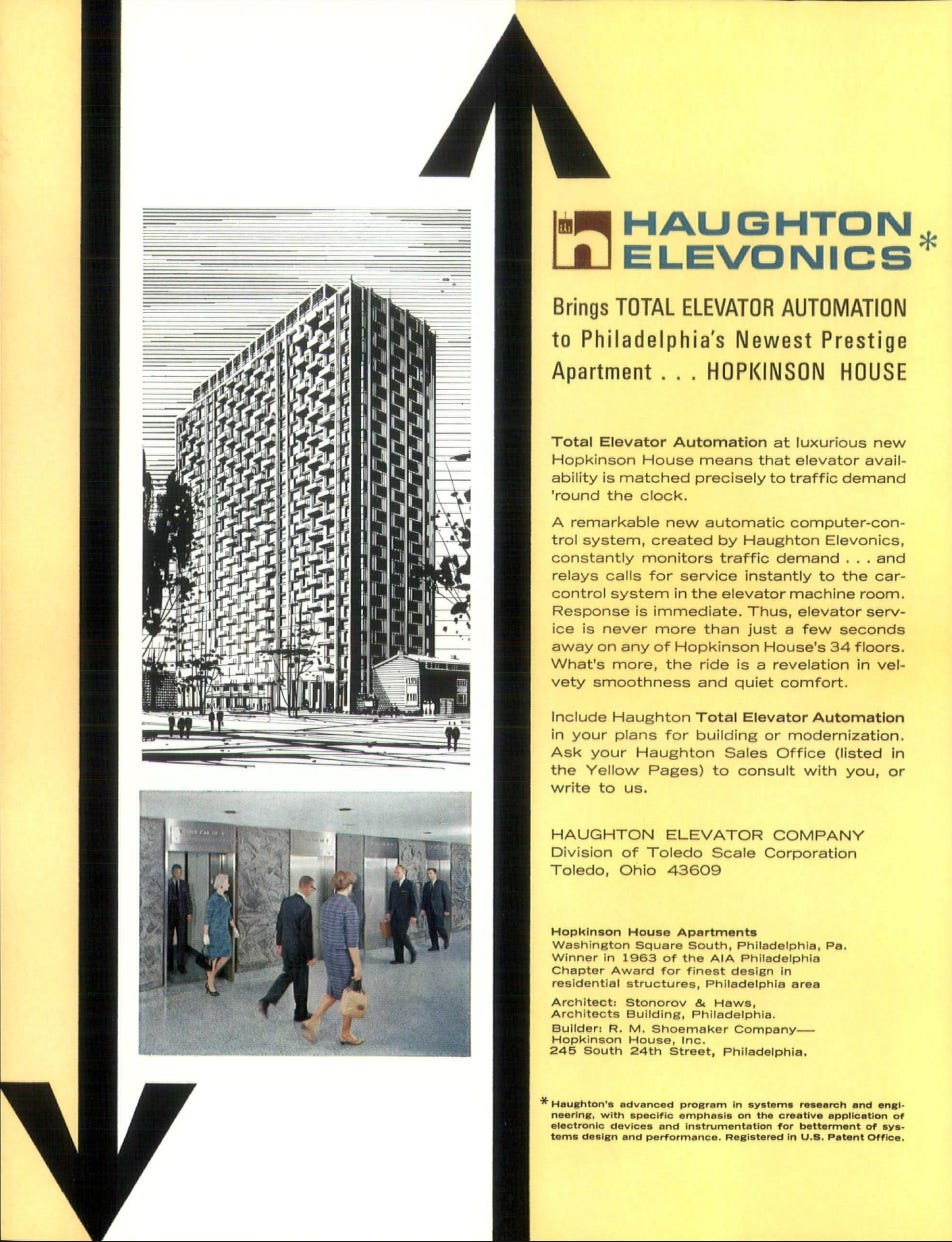
Major Realty envisioned a more ambitious project than Greenfield’s plan—a 320-foot tall, all-concrete skyscraper of modern rental apartments, complete with a rooftop swimming pool and thick, jutting concrete balconies for the majority of units. Hopkinson House would be the largest all-concrete building outside of Chicago and one of the tallest residential buildings in the country. In place of the busy Kling, Major Realty brought on the German-born architect Oscar Stonorov, a close ally of Louis Kahn who had cut his teeth designing influential low-slung housing projects across the Philadelphia metro.
The planned skyscraper soon became a test case for the broader redevelopment of Society Hill. The Federal Housing Administration (FHA), the prime Washington financial backer-agency of the urban renewal project, had the power to insure the hefty mortgages taken out for Hopkinson House and the other new construction efforts in the plan, making the buildings less risky for the private developers who took them on. The FHA, appreciative that the Greenfield-Major deal for the Hopkinson House site had not required federal money for clearance or wheel-greasing, agreed in November 1960 to back 90% of the $10 million mortgage, setting the stage for construction.
The FHA was not, however, as eager to shell out $14.5 million in mortgage insurance for the nascent Society Hill Towers project, the aforementioned I.M, Pei trio of 30-story modernist beasts that was backed by New York real estate titan William Zeckendorf. The project had already required $12.5 million in government subsidies to acquire and demolish the run-down Dock Street Produce Market from whence it would sprout.
FHA District Head William Kelley explained that Hopkinson House’s leasing numbers would show whether modern highrises could draw back one-time Philadelphians who had fled to the suburbs, and thus whether Society Hill Towers was feasible. “If we overbuild apartments down there and have them standing vacant,” Kelley warned, “the city will get a black eye from which it will never recover.” The city redevelopment leaders backing Society Hill Towers, eager to begin building, were aghast. 4
As 1961 began and Hopkinson House pushed ahead, Kelley entered into tense negotiations with the city over the fate of Society Hill Towers. Kelley ultimately agreed to judge the draw of modern apartment towers in the neighborhood (and the resultant mortgage guarantee on Society Hill Towers) on the interest shown in Hopkinson House’s model apartments, rather than on the post-construction leasing data. The four model apartments would be on the building’s first floor and would be ready to tour as soon as construction got that far, moving up the timeline for the decision considerably. 5
Concrete trucks poured in Hopkinson House’s basement floor during Summer 1961, the start of an eventual 29,000 cubic yards of concrete used to construct the tower. 6
In February 1962, the building had risen enough that the ground-floor model apartments, outfitted by nearby department store Strawbridge & Clothiers, were ready for tours. The smallest apartment on display went for $95 a month, while three-bedrooms were in the $400 a month range. Around 5,000 prospective tenants visited the model apartments during their first week, with all of the three-bedrooms in the whole building rented on the first day. 7
The Society Hill Towers backers watched eagerly as their site a few blocks to the East continued to stagnate in uncleared produce market rubble and anxiety. The FHA soon signaled that they were impressed by the rental contracts spurred by the Hopkinson House model apartments. In late March 1962, the FHA agreed to insure the Society Hill Towers’ mortgage. By the end of 1963, Hopkinson House was open and Society Hill Towers was on the rise. 8
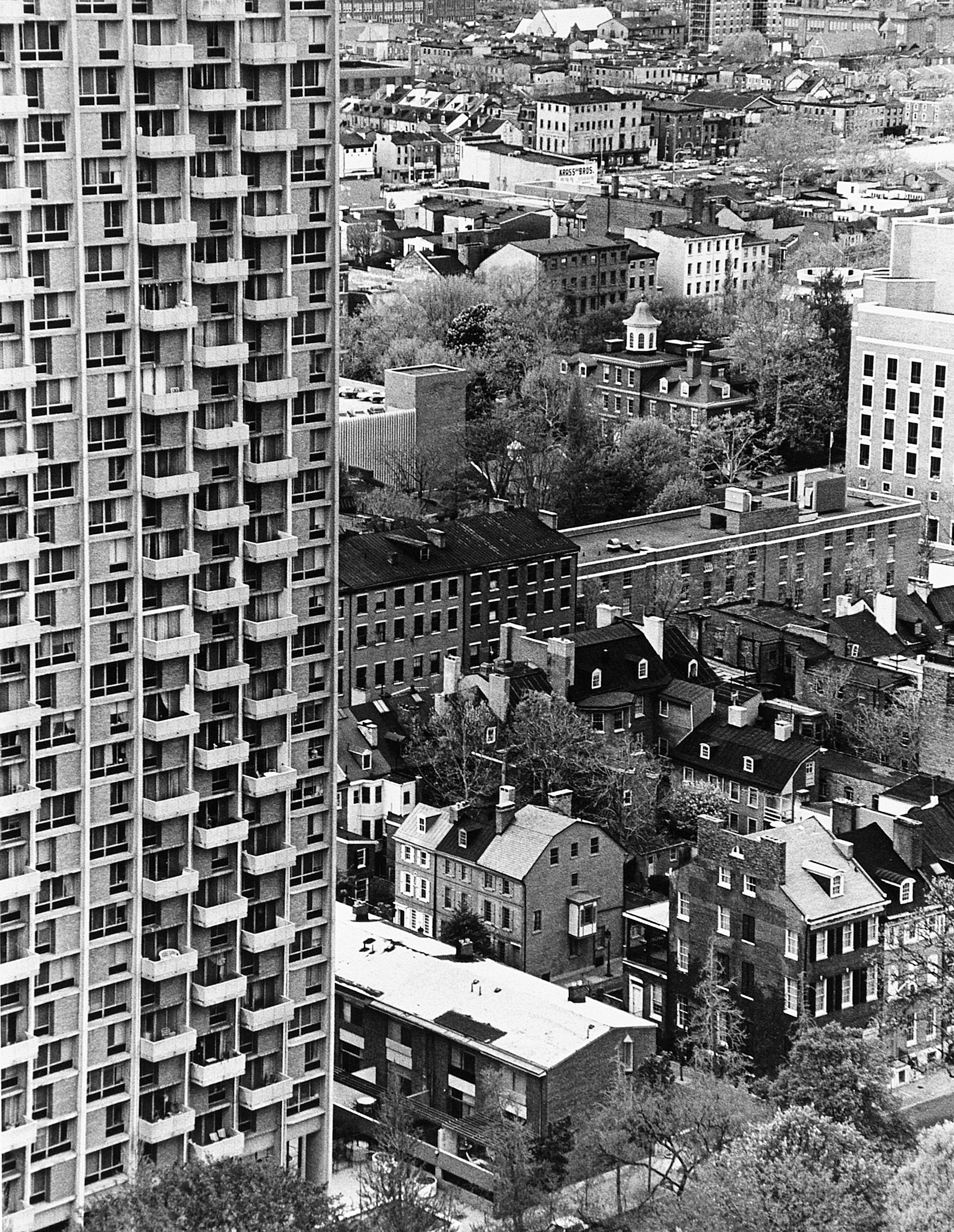
Hopkinson House, this vertiginous building, which caught my eye so early in my Philadelphia residence, had opened the gates far wider to residential skyscrapers in the city, while illustrating the often-blustery midcentury dance between a deep-pocketed but sometimes-skeptical federal government, an ascendent class of entrepreneurial real estate moguls, and a city eager to stem the exodus to the suburbs.
There is, of course, so much more to this story. For one thing, Hopkinson House and Society Hill Towers were just a part of a much larger urban renewal effort. A block north of Hopkinson House was the massive clearance and redevelopment effort of Independence Mall. Sprinkled throughout Society Hill in the blocks around the new apartment skyscrapers were hundreds of colonial-era homes beginning to regain their luster. And alongside the Society Hill residential tower and preservation dual track plan, Philadelphia’s development leaders were simultaneously breaking ground on several other luxury residential towers outside the redevelopment zone, including the Philadelphian, a Miami-vibed behemoth on the Ben Franklin Parkway, and Penn Towers, a sleek Center City building now known as the Sterling.
This Society Hill construction push has been endlessly praised and condemned in the six decades since—an academic and social conversation that I’m still only beginning to get my head around. In 2018, local journalists Jake Blumgart and Jim Saska wrote a powerful Plan Philly essay discussing the legacies of Society Hill’s massive midcentury makeover, which displaced poorer residents and helped set into motion a Philadelphia residential real estate boom and bust cycle that continues to this day.
Beyond the broader impact of Hopkinson House, there’s a lot more to be said about the artistry and architecture of the building itself, particularly architect Stonorov’s collaboration with Florentine sculptor Jonio Vivarelli on a striking, Chagall-like bronze sculpture of Adam and Eve in the outdoor plaza and four bronze elevator reliefs modeled after the Four Seasons.
And there’s a whole secondary real estate story to be told about the conversion of Hopkinson House in 1980 from rental apartments to condominiums, part of a much larger trend that deserves a longer exegesis (and will get one, I assure you!).
For a bit more context in the meantime, check out this 1990s pamphlet, written by journalist Neal Zoren and commissioned by prolific real estate developer and condominium specialist Allan Domb, that further explores some of the quirks of Hopkinson House.
As I continue to learn more about how Hopkinson House and its neighbors grew up, I feel a sense of awe about Philadelphia’s tangled, colorful, and always relevant real estate history—an excitement that I am thrilled to share with you all!
“Site Revealed for New Hotel,” Philadelphia Inquirer (PI), 1/25/1955, 25, and “Apartment-Hotel Site is Assembled,” PI, 11/8/1957, 52.
Dan Rottenberg, The Outsider (Temple University Press, 2013), pg. 229-230.
“Apartments, Hotel Set for Washington Sq.,” PI, 5/6/1960, 1.
Oscar B. Teller, “‘Dream City’ Snag May Last a Year,” PI, 11/26/1960, 33.
Oscar B. Teller, “Dock St. Project Gets VIP Rating,” PI, 1/6/1961, 31.
Oscar B. Teller, “Hopkinson House to Be All-Concrete,” PI, 4/30/1961, 221.
“Hopkinson House Units Opened to the Public,” Philadelphia Daily News (PDN), 2/16/62, 45, “5,000 Visit Apartments,” PI, 2/25/62, 109.
Robert J. Salgado, “Decision Nears on Society Hill Redevelopment,” PI, 3/18/1962, 27.
Love this!